|
-
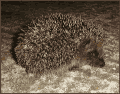
Can be seen from mid-spring to mid-autumn, feeding on slugs,
millipedes, earthworms and caterpillars.
During the day they hide in long grass and hedges and hibernate during the
winter. To encourage hedgehogs into your
garden for hibernation, introduce a winter box, hidden in an abandoned
compost heap, or leave an area in your garden to over grow. Dog and cat food will temp
hedgehogs into the garden, never give them bread or milk as these can cause
their stomach to swell and set off chronic diarrhea. There are several
hazards that can cause real problems for hedgehogs if you have a pond with
steep sides make sure that there is somewhere where they can get out.
Hedgehogs are inquisitive and readily fall into things that they cannot
escape from, look out for breeze blocks, drains without proper grids and empty
pots sunk into the soil with no plants in them. Plastic mesh and discarded
chicken fencing are another danger. If you still have bonfires make sure you
make them and light them on the same day. Terriers, badgers and cars are the
main predators that hedgehogs have to deal with. If you see a hedgehog in
your garden make sure there are no slug pellets about, you do not need to
poison your slugs if you are lucky enough to attract a hedgehog to control
them for you. If you see a hedgehog in a dangerous
place you might be able to move him to a safer garden.
Return to Top
 Badger Badger
Badgers are found throughout the
United Kingdom, but they are known to favor certain habitats where they
can readily dig a deep dry sett. Early surveys show that ninety percent of
the known badger setts are dug into a slope as this helps the animals to
move the soil that they have dug out. They tend to avoid heavy clay soils
and prefer a wooded environment on sandy soils as the tree roots help to
bind the soil and stop the tunnels collapsing. They are able to exploit
the geology of the areas they live in and can often find areas of soil
beneath solid rock for their extensive net work of tunnels.
Badgers prefer to have some cover at
the entrance to their sett so that they can emerge inconspicuously and
have a secure place for cubs to play and learn their environment. Most
setts are in deciduous or mixed woodland although they will live on the
edge of coniferous woods if there are no suitable alternative.
Occasionally setts are found in open ground but this tends to be in upland
areas where there is only a small chance that the animals will be
disturbed.
In the wild earthworms are the most
important thing that badgers eat. This is why they are often found on
cattle pastures and have their setts close by. Badgers will also eat
fruit, root vegetables and bulbs as well as insects and small mammals. You
can attract badgers into your garden by tempting them with other food
items that they cannot find for themselves. They particularly like
peanuts, wet cat or dog food (if you can leave it out without attracting
local felines and canines) as well as apples, pears and plums. I
understand that peanut butter sandwiches and Sugar Puffs are a particular
favorite. Badgers are noisy feeders and really seem to enjoy the things
that they find. In the summer when the grass is dry they will also
appreciate an easy water supply as worms are difficult to find at that
time of the year. Use a heavy dog bowl for water that is difficult to tip
over.
Remember badgers are protected by
the Protection of Badgers Act 1992 and it is illegal to cruelly
treat a badger or damage one of their setts. It is also an offence
to posess a dead badger or sell or keep a live badger. It is OK to feed
and watch them but you must not do anything more than that.
A word of caution
if you watch badgers in the West Country, West Wales or the West Midlands.
Sadly now many badgers here are infected with bovine tuberculosis. Over
the years it has become apparent that badgers are the primary host of
bovine tuberculosis as it spreads and grows more readily in badgers than
it does in cattle or any other species. Sadly nobody will take
responsibility for the welfare of badgers with tuberculosis, they are left
to suffer and die largely un noticed often below ground. Until there is a
fundamental change in our attitude towards diseased wildlife take care if
you go near badger setts or feed them in your garden. Always wash your
hands carefully if you have been out in the countryside and avoid toughing
badgers that have killed on the road.
Return to
Top
Squirrels

There are two breeds of squirrel resident in UK and you are lucky indeed if it
is the Red variety that visits your
garden. Before the grey squirrel was introduced from North America to private
estates and zoological collections in 1876 it was the red squirrel that had a
free run of the country. Red squirrels are only half the weight of their more
robust American cousins. They are adapted to coniferous woodland and cannot
digest the hazelnuts and acorns found in deciduous woodland. Because of this
our native squirrel is confined to coniferous woodland in Scotland, in the
north of England and small isolated areas of Wales. Red Squirrels are fully
protected by schedule 5 of the wildlife and countryside act 1981 and are
actively supported by the provision of feeding stations, nesting boxes and
ropeway over busy roads to encourage their continued survival.
Squirrels breed between December and January and again in
August and September. Red squirrels can have as many
as eight offspring whereas three is the average size of a grey squirrel’s
litter. They are born with no hair and do not get a full covering until three
weeks of age, they will not venture from the nest until another three weeks
have passed.
Grey squirrels have a natural curiosity and
will do anything for a peanut so they can readily be attracted to garden bird
feeders if you give them half a chance. Peanuts and sunflower seeds are not a
balanced diet for rodents however and can cause problems in juvenile animals
if they take them in excess in preference to wild food. If you have a family
of young squirrels that come regularly to your garden try introducing them to
rodent pellets or a quality dry puppy feed to give then a more balanced
feed.
Squirrels have few natural predators buzzards
are said to take them although they will have problems catching them in wooded
areas, and are more likely to come across animals killed on the road. Cats and
terriers may kill squirrels if they get caught out
in the open. In the autumn there always seems to be a period when many
squirrels get run over presumably as they take more risks to build up their
food stores for the winter.
Take great care if you find an injured squirrel, they are
wild animals that have a viscous bite and do not adapt readily to captivity.
The adults are unfortunately difficult animals to treat and present us with a
difficult problem as it is an offence under the Wildlife
and Countryside Act to
release grey squirrels back into the wild.
Return to
Top
Urban Fox

We work in a beautiful part of
rural Shropshire and have no experience of urban foxes. Over the years we
have had the opportunity to treat foxes that have been hit by cars and on
one occasion an individual that was reared in a Public House, but became
more and more unmanageable as he grew older. Rural Foxes behave in a
different way to their urban cousins. They tend to be more wary of people
and visit our gardens only to harvest our ducks and poultry rather than
investigate any easy source of unused food that we are throwing away. As far as I know nobody
in our immediate area is feeding foxes in their gardens.
Foxes mate in the middle of the
winter and cubs are born in March and early April. The Urban Fox has a
smaller territory than the ones that we see as their food is easier to
find. They tend to like quieter areas where there are owner occupied
houses and railway embankments where they will not be disturbed too often.
They tend to have several dens and regularly move between them depending
on how safe they feel and how easy it is for them to get food. It is not
until the cubs are five weeks of age that they are seen above ground.
More than half of the cubs born do
not get to their first birthday. This is mainly because of accident than
deliberate control measures. It is rare for a fox to survive for more than
five years and they will breed from a younger age if their numbers are
low. They have a varied diet and particularly like meat, as well as earth
worms, bread, fruit and potato peelings. They like the take a ways that we
discard and get to know the waste bins where the remains of our meals are
likely to be discarded.
When ever we see sarcoptic mange in
dogs there has been some contact between our patient and a fox. Often it
might just be that they have investigated a fox hole or come across a dead
fox on a road. Fortunately sarcoptic mange is much easier to treat now
that Stronghold is in all of our Surgeries. This is a mite that burrows
into the skin and will cause intense irritation. Two applications of the
drug are needed and sometime we have to use other drugs to stop the
itching and limit the skin damage.
Return to Top

Mole
Moles are
fascinating animals but not everybody welcomes them into their garden.
Seldom seen we always know where they are and sometimes spend a great deal
of time trying to persuade them to live somewhere else.
There are 29
species of mole world wide yet it is only the European mole Talpa
europea that we have in the United Kingdom. There are no moles in
Ireland. These busy animals can grow to 16 cm in length and have been
known to dig more than 20 metres of new tunnels in a day. They are
unusual in the way their fur grows at right angles to their skin so that
they can move forwards and backwards in their tunnels. They have very
small eyes and small ears and rely almost entirely on their sense of smell
and their ability to detect small vibrations in the soil.
Moles are
solitary creatures who are aggressive to their own kind and only tolerate
one another when the sow wishes to mate. They can have up to four
offspring who are hairless when first born, but ready to leave the
mother's territory after five to six weeks. This is the only time that
they are seen above ground and they are very vulnerable to predators when
they move away from home.
Moles have a
varied diet of earthworms, leatherjackets, wireworms and slugs so they are
not all bad and they do tend to aerate the soil and leave little piles of
soil that is ideal for potting compost. They have a high metabolic rate
and must eat every few hours to avoid starvation it is hard work for them
to consume half of their body weight in food every day to keep alive.
There are no easy
ways to deter moles. We tend to get one in the same area of our garden
each winter. I have tried up turned bottles on a stick and various things
that make a noise in the wind without a great deal of success. Sometimes
things go quiet for a while so that I think he has gone and then he starts
digging again with renewed vigor. Our mole always seem to disappear in the
spring when I start to mow the grass. To be fair it does not take very
long to repair the damage that he has done and make the lawn level again
so we have grown to respect one another now.
If you are
interested in moles you might like to take part in the
Mole Watch Survey. There is an
opportunity to get your moles on the map.
Return to
top.
Otter
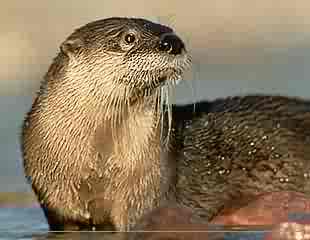
In many
ways I am pleased that I can find a reason to include the British Otter
Lutra l. lutra here. Silent and secretive it is most unlikely that you
would ever be lucky enough to see one of these wonderful creatures in your
garden, but they are about during the night and if you keep fish in a pond
you may well know to your cost just how efficient this aquatic hunter is.
From
time to time we have had early morning sightings of Otters in Minsterley
and under the Welsh Bridge in Shrewsbury. Twice there have been road
casualty cases found near a bridge at Chirbury and once in Pontesford.
There is at least one Otter active in Church Stretton as two garden ponds
have been raided last summer. It is usually the biggest most
valuable fish that they take first.
Otters
are members of the mustelidae family that includes stoats, polecats and
badgers. They are the top predator of our rivers and water courses and
have to eat 1 to 1.5 kg of fish each night to maintain their body weight.
Dog Otters can weight up to 14 kgs which is nearly twice the size of the
females. They have small eyes and ears and can close their nostrils when
they are under water. Otters have a short dense coat of hairs close to the
skin and a longer top coat of stiff guard hairs that can trap air to act
as insulation when they are under water.
It is
thought that most dog otters have a home range of twelve or more miles of
river and females will patrol for eight miles. They are constantly on the
move and regularly scent mark at prominent places to communicate their
presence to others. It has been found that in rivers that contain salmon
and trout these fish will be only 10% of their diet, the rest is mainly
eels, course fish with some amphibians, small mammals and birds.
It is
encouraging to find that Otters are once again able to establish
themselves in our rivers, sometimes along quite small water ways. They
have few natural predators as long as the water quality in their extensive
territory is maintained. Sadly it is motor vehicles that are one of the
main treats to their survival.
Return to Top
|
Common/ Hazel
Dormouse
(Muscardinus avellanarius)
|
|
The
common dormouse is a small native rodent, not to be confused with the much
larger edible dormouse, which was introduced into Britain by the Romans as a
food source. Dormice are omnivorous and tend to live in mixed hazel woodland
with honeysuckle. They are very long lived for such small rodents, with over
5 years having been recorded and it’s been suggested this is because they
spend so much time in hibernation or torpor (a state of reduced metabolic
drain). Over winter dormice hibernate in leaf litter and around April/May of
each year they wake up to feed and nest. They build many beautifully woven
nests during a single season and females produce on average 5 babies per
litter with only one, maybe two litters in a year. Over recent decades the
common dormouse has undergone a population decline, probably due to loss of
habitat, reduction in mixed woodland and possible climate change. However,
due to recent conservation work, the dormouse is making a comeback.
Populations have been re-introduced in Cheshire and Derbyshire and found in
Shropshire and Denbighshire.
This small rare rodent is found in
this
area around
Habberley
and parts of the Hope Valley, but you are unlikely to be lucky
enough to see one. Occasionally torpid dormice are found over winter in
peoples sheds or wood/compost piles. If this happens it is best to replace
the sleeping animal and try to leave the area undisturbed until spring/ summer
to allow it to safely hibernate.
If you do have a burning desire to
see a dormouse, one of the best ways is to join a monitoring team organised by
the Shropshire Wildlife Trust, Peoples Trust for Endangered Species or
Forestry Commission. There are several projects going on at the moment in the
Shropshire/Cheshire area and volunteers are usually welcomed, unless days are
very oversubscribed. Dormice are fully protected by law and a licence, issued
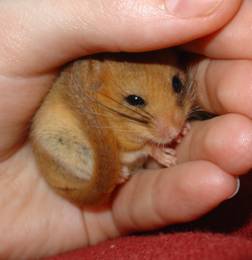
by English Nature, is required to disturb, handle or photograph them. The
photograph on this page was taken during routine monitoring of nest boxes and
shows a young adult female.
Red Kite
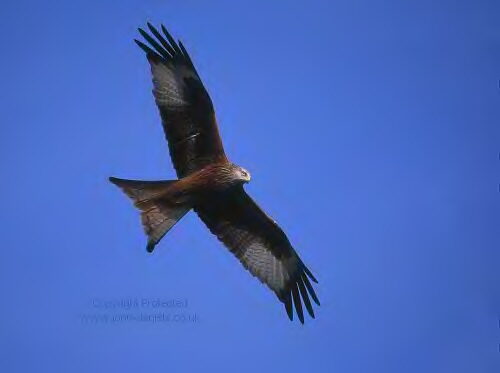
Milvus milvus
larger than a buzzard these magnificent
birds have a wingspan of up to two meters yet weigh no more than 1.5kgs. They
tend to fly low over fields and forests as they prey on small mammals and
amphibians. Earth worms make up a substantial part of their normal diet. They
are opportunists but they not big enough to open the carcass of larger animals
so they have to wait until some other predator comes along to get things
started.
In past times Red Kites
were though of as vermin and they were easy targets for game keepers and
farmers protecting their stock. At the turn of the 20th century there were
just a few pairs left in west Wales and none in the whole of the rest of the
country. Times have now changed and with a lot of help numbers had increased
to 77 pairs in Wales by 1991, all of these individuals are thought to have
descended from one female bird. Numbers have increased considerably now both
in Wales and in various sites in England where careful introductions have been
made. These birds will live close to towns and do not seem to be concerned by
people, they will often hover close by if you are on a walk to keep an eye on
what you are doing.
Here in Shropshire we are
just starting to see Red Kites between the Stiperstones and the Longmynd and
occasionally between Pontesbury and Minsterley. Hopefully if they do not have
too much competition from the buzzards they will become a common sight as they
start to get established in our area.
Return to Top
|

